How will the Corona crisis affect our public space?
UrbanCommunityCentralDynamicFamily
Carasso
Lately, we have spent most of our time at home. We have all sat between four walls and looked longingly at the empty amusement parks and abandoned fitness complexes. Even a coffee on the boulevard has become a distant dream. The prolonged lockdown has emphasized to all of us the importance of public spaces, which allow for leisure and community activities. The question is, have we learned anything from this period? Will the coronavirus bring about a real change in the perception of
Lately, we've spent most of our time at home. We've all sat between four walls and looked longingly at the empty amusement parks and abandoned fitness complexes. Even a coffee on the boulevard has become a distant dream. The prolonged lockdown has emphasized to all of us the importance of public spaces, which allow for leisure and community activities. The question is, have we learned anything from this period? Will the coronavirus bring about a real change in our perception of the home and public spaces?
"This great obstacle that has befallen us is a great disaster, which could lead to a fundamental change in the perception of space. It is a dramatic event in the sense that it is global and multidisciplinary, it touches everything. In my opinion, this is a Third World War of a completely new kind," says architect and urban planner Dr. Ronit Davidovich.
Overcrowding reinforces the need for public spaces
Years of shrinking living space
But it wasn't the coronavirus alone that led to this feeling. For decades, our living spaces have been getting smaller, becoming more and more functional. Our space outside is also shrinking, private means of transportation are compensating for the lack of public transportation, and dense projects are being built under state sponsorship to address the housing shortage. The introduction of concepts such as mixed-use and urban renewal have also contributed to a dramatic change in the discourse. This trend reinforces the need for significant public spaces and urban planning that will enable them, but in practice it pushes them aside.
A little history: Even before the establishment of the state, emphasis was placed on the planning of public spaces. There was investment in the development of public spaces between buildings, this was the method for balancing urban density. The first outline plan for the city of Tel Aviv, the 'Geddes Plan', is an example of such planning, and the neighborhoods of the old north are its remains. The young state also maintained this character - the development towns were planned with wide streets, squares and public spaces.
Remnants of the 'Geddes Plan'
In the 1970s, the state cut investment and the authorities were forced to balance the resulting shortage with the help of the private sector, while at the same time the maintenance of the green lungs was neglected. The improvement in the economic situation of residents led to the displacement of pedestrians in favor of private vehicles entering the cities. The new trend was to create designated recreational areas and, as a result, the connection between housing and public spaces was gradually severed. Today's developed cities behave like companies in the private sector: they are in constant competition for investments, areas and budgets. The public space has a high consumption potential and has thus become a magnet for income for the municipality. Social and environmental interests are often pushed aside.
Private parking or a picnic area?
A gap has emerged between the talk of optimal planning among professionals and the plans that are actually approved, which are the result of considerations and constraints. The result can be called "sleeping neighborhoods," the kind that will actually encourage us to get in the car to buy groceries or have a coffee, and certainly to get on the train. What's the logic? A commercial floor in an apartment building may lower the value of the apartments, land outside the train route will be cheaper. This tug-of-war has always existed, and the question arises, what does the city need more, an additional parking space or a place to spread out a picnic blanket? Now Corona has arrived and changed the balance of power between them.
Pedestrians are pushed aside
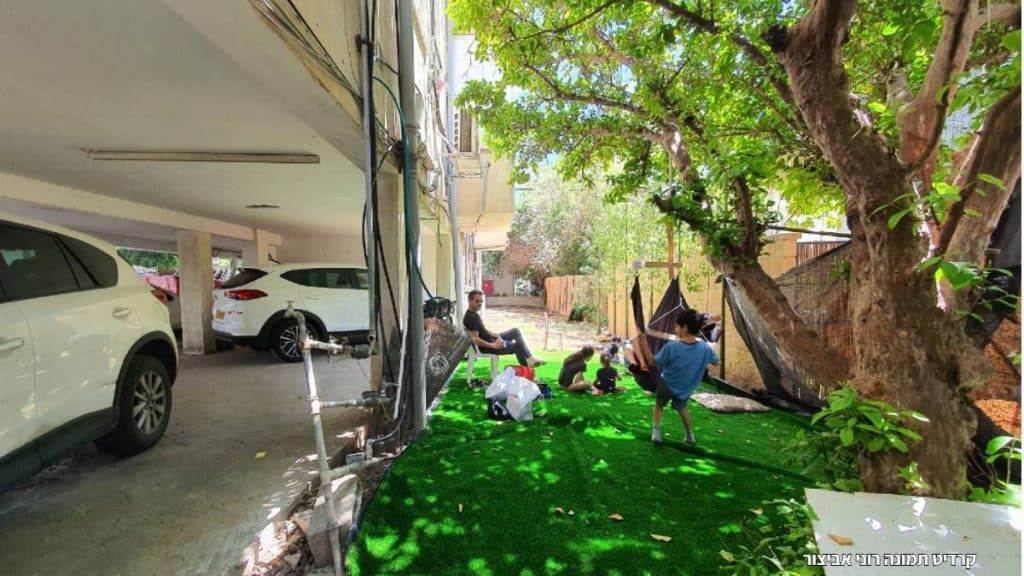
"Right before the coronavirus broke out, in one of the public participation meetings around urban renewal , there was talk of not everyone having to have private parking within the Dan Bloc, and people did not agree to accept that. And here comes something very big, which takes us out of our comfort zone and forces us all to get used to a new reality. During the coronavirus period, I saw a private parking lot of a building that was converted into a shared courtyard, and this trend will continue," Dr. Davidovich estimates.
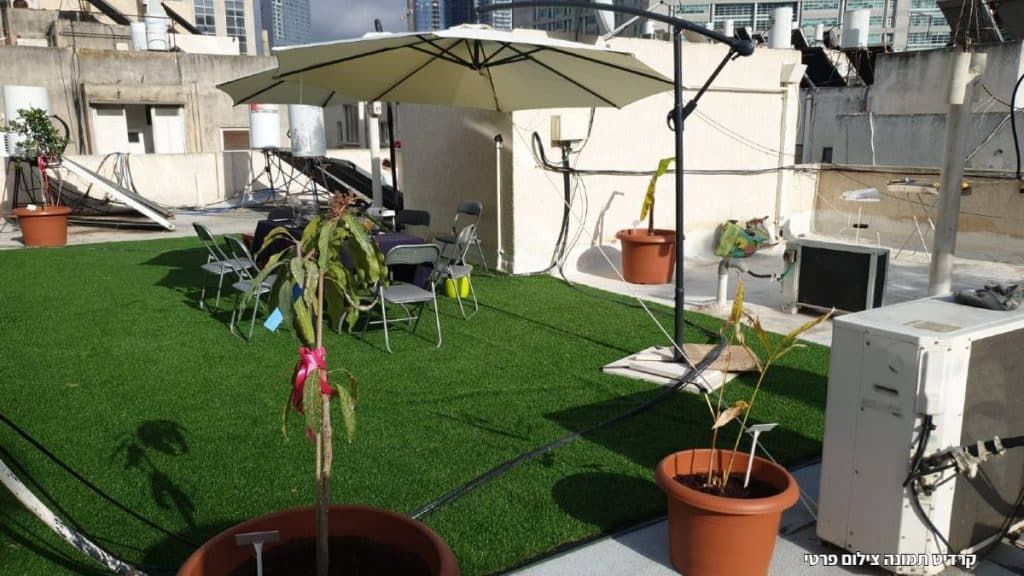
Parking converted into a shared yard A roof converted into a common area for the well-being of the residents
A period of change in perception
Dr. Davidowitz is certain that the recent period will affect the perception of the home, the perception of organization, and even the perception of time. "People have realized that they can work great from their home, which remains empty in the morning hours. The hours of activity will change dramatically. Working from home saves on traffic jams and Zoom puts us into a clear time frame. In this respect, the home returns to the traditional concept but from a new and smart place, with spaces that allow for a greater variety of uses."
Architect Ofer Rossman of Studio XS, which specializes in small space planning, points to immediate changes. "Following the forced lockdown, people discovered the importance of planning their immediate environment and the potential it holds. There was a lot of creativity during this period and we are seeing a change in perception in the way we relate to shared spaces. For example, the volume of cars has decreased significantly, which has allowed the vehicles to be removed from the building's parking lot and the space to be utilized for new purposes. Shelters and roofs, which are usually used as storage, have been converted into gyms."
A new type of traditional house
"The lockdown has caused us to change our perception of the home. For example, we are used to counting rooms in the house – bedrooms, living room and kitchen. What is the relevance of this division when recently the bedroom has become a study and the kitchen has been converted into a study corner and a Zoom stand? The immediate definitions of the home have changed completely. The only space that has always been creative and flexible in terms of uses is the balcony. It has no fixed function and can be used to entertain, cook, exercise and watch TV. Responses from families with and without balconies were significant during this period. The issue of acoustics has become significant and will receive a new focus. The perception of lobbyists is also taking a twist. If until now there was talk about the height of the lobby and the standard of the countertop, then today there is interest in materials that provide an antibacterial solution and an app through which we can order an elevator to avoid pressing the button. The planning and regulatory authorities received feedback from the field and issues that had been on the table for years and had not progressed, suddenly received "High priority."
"We will return to the public space out of appreciation for the community and appreciation for the local culture," Davidovich concludes. "When we finish our gathering, we will hold our heads high and behave much smarter within the thousands of kilometers we have traveled."